
Why Semiconductor Ecosystem Suppliers Are Expanding Production in Vietnam
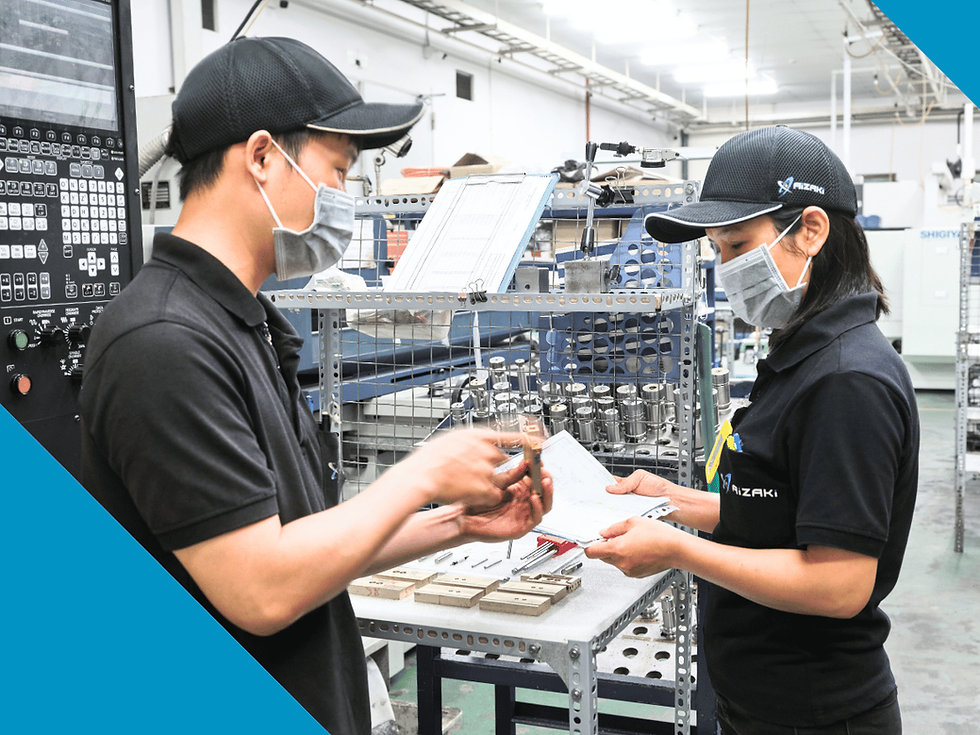
When semiconductor equipment manufacturers invest in new production capacity, they rarely move alone. Behind every lithography tool, deposition system, or wafer processing unit stands a network of specialized component suppliers – valve manufacturers, fluid control equipment makers, connector producers, gas delivery system builders – whose own production decisions follow the same geographic logic. In 2026, that logic increasingly points toward Vietnam.
This article examines what is drawing semiconductor ecosystem suppliers to expand manufacturing operations in Vietnam, what the trend means for the precision machining supply chain that supports them, and why US and European sourcing teams should pay attention.
A Market That Rewards Proximity
The semiconductor manufacturing equipment market is in a period of sustained, structural expansion. According to SEMI's year-end forecast released at SEMICON Japan 2025, global semiconductor manufacturing equipment sales by OEMs are projected to reach a record $133 billion in 2025, a 13.7% increase year-on-year, with continued growth to $145 billion in 2026 and $156 billion in 2027. These are figures driven primarily by AI-related demand for advanced logic and memory, and by the capital intensity of next-generation node transitions.
What matters for sourcing professionals is where this equipment gets built, and where the components inside it get machined. China, Taiwan, and Korea remain dominant in equipment spending through 2027, while other regions are expected to see increases supported by government incentives, regionalization efforts, and specialty capacity expansions. Vietnam sits squarely in the path of that broadening investment map – and the component supply chains that feed it are following.
Vietnam's Semiconductor Infrastructure Is No Longer Aspirational
A few years ago, Vietnam's semiconductor story was largely about ambition and assembly-level operations. That has changed. Vietnam's semiconductor market is projected to reach $31.28 billion by 2027, growing at a CAGR of 11.6% from 2023 to 2027, as the country moves beyond its foundation in chip assembly and testing toward a broader semiconductor ecosystem.
The policy framework has kept pace with the investment. In September 2024, the Prime Minister issued Decision No. 1018 approving the National Strategy for the Development of Vietnam's Semiconductor Industry to 2030, with a vision extending to 2050. Further institutional support came with the adoption of the Law on Digital Technology Industry in June 2025, effective from January 1, 2026, which creates a legal foundation for semiconductor and emerging technology sectors, including performance-linked incentive structures for R&D centers and high-tech manufacturing. On the ground, the milestones are tangible. Vietnam broke ground on its first high-tech semiconductor chip manufacturing plant on January 16, 2026 – a step that signals commitment well beyond the planning stage. Amkor Technology has invested $1.6 billion in an advanced packaging plant in Bac Ninh – its largest globally – supporting high-performance parts for AI, 5G, and automotive, while Hana Micron has committed approximately $930 million in investments by 2026 to expand chip-packaging capacity. In July 2025, Coherent opened a $127 million facility in Dong Nai producing silicon carbide components, optical glass, and precision photonics for AI and cloud datacom supply chains.
These are the anchor investments that pull the broader ecosystem behind them.
The Ecosystem Effect: Valve Makers, Fluid Control, and Precision Components
The headline investments in packaging plants and fab infrastructure tell only part of the story. The semiconductor supply chain runs on thousands of precision-machined components – valve bodies, pressure sensor housings, flow controller enclosures, connector assemblies, chemical delivery fittings – manufactured by specialized companies whose production capacity must scale alongside the equipment makers they serve.
Fujikin, Japan's leading manufacturer of ultra-precision valves for semiconductor manufacturing equipment, has operated in Vietnam since 2002 and now runs two factories (Thang Long and Bac Ninh) with approximately 1,400 employees. The company's Vietnam operations produce semiconductor equipment valves and fittings, with the Thang Long factory focused on precision machining of components – primarily from 316/316L stainless steel – and the Bac Ninh facility specializing in unit assembly. Fujikin has continued adding production lines in Vietnam, and the company's medium-term strategy positions Vietnam as the primary supply base for European and American customers' Southeast Asian production sites.
Fujikin is one example of a broader pattern. Across the semiconductor ecosystem, Japanese manufacturers of valves, fluid handling systems, gas delivery components, and precision fittings are expanding their Vietnam-based production to meet rising global demand. The machining requirements these companies carry with them are specific and demanding: tight tolerances on stainless steel and specialty alloys, internal surface finishes measured in fractions of a micron, full dimensional traceability, and cleanroom-compatible handling protocols – all at batch sizes that reflect engineered component manufacturing rather than commodity mass production.
What China+1 Means for the Precision Machining Layer
The supply chain diversification strategies commonly described as "China+1" have been discussed for several years, and Vietnam has consistently emerged as a primary beneficiary. Vietnam's semiconductor market is forecast to reach $10.16 billion in 2025, with a structural shift underway as global manufacturers seek to diversify supply chains away from China. The Vietnamese government has elevated the semiconductor sector to a national priority through Strategy 1018, which mandates the training of 50,000 to 100,000 engineers by 2030, with over 137,000 students already enrolled in related fields as of the 2025 admissions cycle.
For sourcing engineers at semiconductor ecosystem companies, the practical implication is straightforward: as your production moves to Vietnam, your machining supply chain should be evaluated in the same region. The advantages of geographic proximity – shorter logistics chains, aligned time zones for communication, faster pilot-lot iteration, reduced lead-time variability – compound when the machining partner already understands the materials, tolerances, and documentation standards that semiconductor-grade components demand.
What This Means for Sourcing Teams Evaluating CNC Partners in Vietnam
Vietnam's manufacturing base has matured considerably, and the precision machining segment is no exception. The country now hosts CNC facilities with 5-axis machining capability, CMM-verified inspection, multi-process integration (machining through finishing and assembly), and the quality management infrastructure that semiconductor ecosystem companies require.
The critical qualification criteria for a CNC partner in this space go beyond machine capacity. Sourcing teams should evaluate whether a potential supplier has demonstrated capability in the materials specific to semiconductor ecosystem components – 316L and 316 stainless steel, specialty alloys, and fluororesin-compatible metals. They should look for evidence of sub-micron surface finish achievement, documented traceability from raw material through final inspection, and a production philosophy oriented toward precision-batch manufacturing discipline rather than high-volume commodity output.
At Aizaki Vietnam, these are the standards we hold ourselves to every day. Our Japanese engineering roots, structured onboarding process, and investment in 5-axis CNC, multi-axis turning, wire EDM, grinding, and CMM verification reflect a deliberate focus on the precision-batch machining that semiconductor and aerospace supply chains demand. If your organization is evaluating CNC partners to support expanded production in Vietnam, we welcome the conversation.
References
SEMI, "Global Semiconductor Equipment Sales Projected to Reach a Record of $156 Billion in 2027," SEMICON Japan 2025, December 16, 2025. https://www.semi.org/en/semi-press-release/global-semiconductor-equipment-sales-projected-to-reach-a-record-of-156-billion-dollars-in-2027-semi-reports
SEMI, "Accelerating Ahead: How Vietnam is Building a Competitive Semiconductor Hub," September 2025. https://www.semi.org/sea/blogs/September-2025
Deloitte Southeast Asia, "Vietnam's semiconductor strategy: From vision to values," October 2025. https://www.deloitte.com/southeast-asia/en/services/tax/perspectives/vn-semiconductor-en.html
Vietnam.vn, "Vietnam is beginning to lay the groundwork for the development of the semiconductor industry," March 2026. https://www.vietnam.vn/en/viet-nam-buoc-dau-hinh-thanh-nen-tang-phat-trien-cong-nghiep-ban-dan
SEMI, "Vietnam's Semiconductor Pivot: From ATP Workhorse to Front-End Contender," 2025. https://www.semi.org/sea/blogs/Vietnams-Semiconductor-Pivot
The Investor (VN), "Vietnam shifts up semiconductor value chain as global chip makers seek 'China+1' resilience," January 7, 2026. https://theinvestor.vn/vietnam-shifts-up-semiconductor-value-chain-as-global-chip-makers-seek-china1-resilience-d18046.html
JETRO, "Semiconductor equipment valve manufacturer Fujikin expands Vietnam production amid surging demand" (interview with Fujikin Vietnam General Director), January 2026. https://www.jetro.go.jp/biz/areareports/special/2025/1001/cbb782769608177f.html


